Project case study
Anemo
Making data structures and algorithms easier to see, explore, and understand.
- Role
- Frontend Developer, Product Designer & Open-Source Maintainer
- Status / year
- Active · 2026
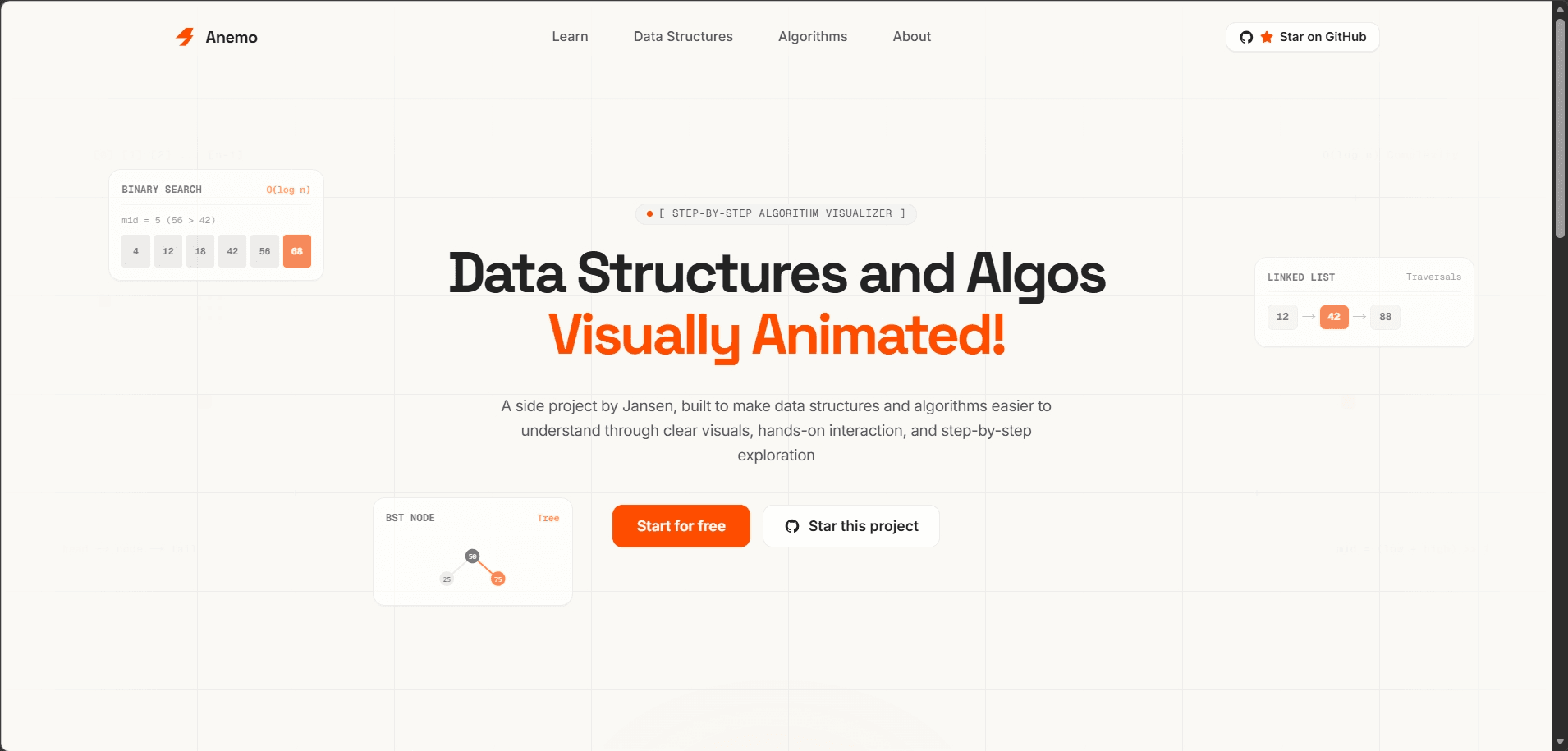
Overview
Data structures and algorithms are often taught through definitions, pseudocode, and finished solutions. This can explain what an algorithm does without showing how its state changes while it runs.
Anemo is a free, open-source learning platform designed to make those changes visible. It focuses on visual reasoning, step-by-step exploration, and understandable explanations instead of relying on memorization alone.
The learning problem
Students commonly encounter arrays, trees, sorting algorithms, and complexity notation as abstract rules. Without seeing values move, variables update, and decisions happen in sequence, it is difficult to build a reliable mental model.
The goal of Anemo is not to replace code or theory. It is to provide the visual layer that helps learners understand what the code is actually doing.
A visual-first learning system
Anemo organizes data structures, algorithms, complexity concepts, and structured learning paths inside one consistent educational interface.
The planned visualizer system will connect animated state changes with pseudocode highlighting, variable inspection, playback controls, and plain-language explanations. Each part is intended to update from the same deterministic execution state.
- Step-by-step algorithm playback
- Editable inputs and repeatable execution
- Synchronized pseudocode and variable state
- Visual explanations of operations and complexity
- Structured paths for learning DSA foundations
Designing an educational developer tool
The interface combines the clarity of an educational product with the restraint of a modern developer tool. It uses strong typography, compact navigation, technical grid details, and a focused orange accent without turning the experience into a conventional dashboard.
Catalogue pages prioritize scanning and information density, while the homepage establishes the visual identity. Shared layout rules, accessibility requirements, responsive behavior, and reusable components keep the public frontend consistent as the project grows.
Building in the open
Anemo is prepared as an open-source project with an MIT license, contribution guidelines, issue templates, documented design rules, and a public roadmap.
The current frontend establishes the project structure, learning catalogues, responsive design system, and public-facing experience. The next technical milestone is the first complete array visualizer and Bubble Sort lesson.
What the project demonstrates
Anemo demonstrates educational product thinking, frontend architecture, responsive interface design, technical content organization, and open-source project maintenance.
It also shows a deliberate approach to building interactive systems: establish one understandable execution model first, validate it through a complete learning experience, and only then expand it across additional algorithms and data structures.
Technology
- Next.js
- React
- TypeScript
- Tailwind CSS
- shadcn/ui
- Motion