Building Abstruck for Knowledge I Can Return To
The product thinking behind turning long recordings into searchable, source-linked knowledge instead of another disposable AI summary.
- product-design
- ai
- engineering
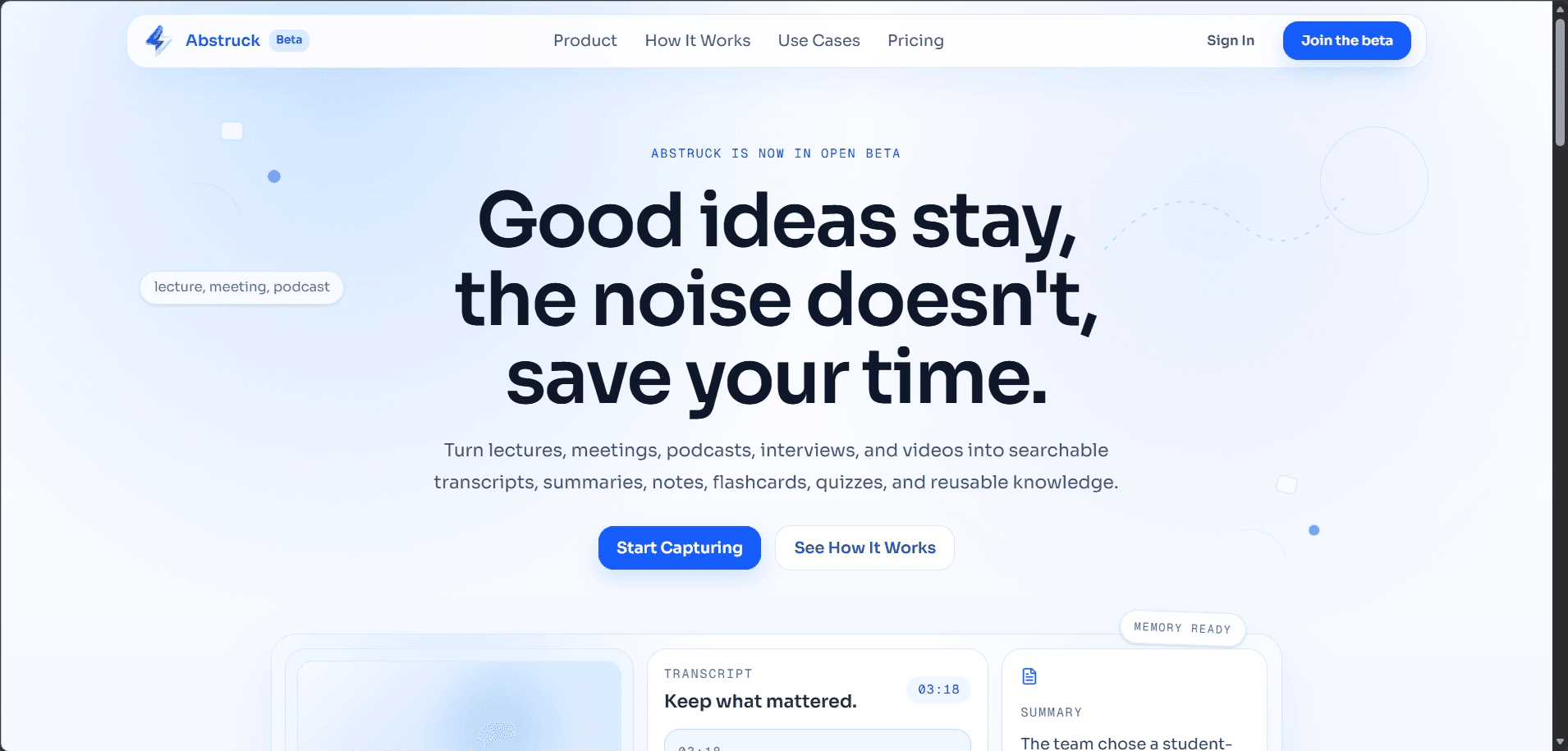
Abstruck began with a problem I kept experiencing personally: I could spend an hour learning from a lecture, tutorial, podcast, or meeting, then struggle to return to the one explanation that mattered most.
The knowledge was technically still there. It was just trapped inside a timeline.
I did not want to build another tool that produces a paragraph of AI-generated text and calls the problem solved. A summary can be useful, but it can also flatten context, hide uncertainty, and become disconnected from the source that made it valuable.
I wanted Abstruck to preserve spoken knowledge as something I could search, verify, study, and revisit.
The product question
The first version of the idea was broad: turn recordings into useful learning material. That sounded promising, but it was not specific enough to guide a product.
I narrowed it to one question:
How can a long recording become a trustworthy workspace without losing the connection to what was actually said?
That question changed the feature priorities. Transcription was only the foundation. The real product had to help someone move through four actions:
capture -> understand -> remember -> retrieve
- Capture: bring an audio or video recording into the workspace.
- Understand: read the transcript and generate a structured, cited summary.
- Remember: turn the material into personal notes and flashcards.
- Retrieve: return to a timestamp, search an idea, ask a grounded question, or export what matters.
This became the clearest model I had for deciding what belonged in Abstruck and what could wait.
Designing for trust, not AI spectacle
Many AI products make the model the center of the interface. I chose a different direction. In Abstruck, the recording and transcript are the source of truth. Generated outputs sit around that source and should help a person navigate it.
Timestamp citations became one of the most important product decisions. A summary claim should lead back to the moment it came from. A chat response should be grounded in transcript segments. If the recording does not support an answer, the interface should be honest about that instead of inventing confidence.
That principle affected the whole system:
| Product output | Its connection to the source |
|---|---|
| Summary | Claims include timestamp citations |
| Chat | Answers use transcript segments as evidence |
| Notes | Personal writing stays distinct from generated content |
| Flashcards | Prompts and answers come from the recording |
| Exports | Useful material remains portable beyond the app |
The goal is not to make AI feel magical. It is to make the result useful enough to trust and clear enough to verify.
The visual direction
I designed Abstruck as a calm knowledge studio rather than a futuristic AI dashboard. The product uses a light paper-like canvas, compact controls, quiet blue borders, and one controlled action color. The interface needs enough density to support serious review, but enough space to prevent a long transcript from feeling exhausting.
I was especially careful not to turn every capability into a floating card. Transcript views, notes, citations, flashcards, and export tools already create complexity. The visual system has to organize that complexity, not decorate it.
This is also why the public landing page shows the workflow instead of relying on vague claims. Real product states are stronger evidence than artificial social proof, especially while Abstruck is still in beta.
What challenged me technically
The hardest part was not calling a transcription API. It was building a dependable flow around work that takes time and can fail.
An uploaded recording moves through several systems:
private upload
    -> temporary signed access
    -> asynchronous transcription
    -> normalized transcript segments
    -> cited knowledge tools
    -> saved or exported output
The application has to communicate uploading, transcribing, completed, and failed states honestly. It has to protect each recording behind its owner, keep provider credentials on the server, and remove temporary source media after successful processing.
I also needed one stable transcript structure that summaries, chat, citations, notes, and flashcards could share. Without that boundary, every new learning tool would interpret the recording differently. With it, features can grow around the same source-linked model.
That is where Abstruck has pushed me most: connecting product design with backend responsibility. A polished workspace is not meaningful if ownership checks are weak, processing states are misleading, or generated material cannot be traced.
Why Abstruck matters to me
I am building Abstruck because it sits directly inside the kind of future I want to create: ambitious software that uses AI to strengthen human understanding rather than replace it.
It brings together the work I care about most—product strategy, interface design, full-stack engineering, information architecture, and responsible AI behavior—inside one problem that is genuinely useful to me.
The beta is not the finished vision. There are limits I am deliberately honest about: no global library chat, knowledge graphs, live transcription, or collaborative workspaces yet. Naming those limits helps me protect the core workflow instead of pretending the product is larger than it is.
The long-term ambition is bigger than summarization. I want Abstruck to become a second brain for spoken knowledge: a place where lectures, discussions, and ideas do not disappear when playback ends.
What I am carrying forward
- Start from a retrieval problem, not from an AI feature.
- Keep generated claims connected to evidence.
- Make user-authored knowledge visually and structurally distinct.
- Design waiting, failure, and incomplete states as part of the product.
- Let real workflows prove value before expanding the feature list.
Abstruck is teaching me that ambitious products do not begin by trying to look big. They begin by being precise about what should become easier, more trustworthy, and more lasting.